
TWO: Colonel B. Heneker, a regiment, and ¡ê3,500 a-year for his seat.In the following Session Fox introduced a Bill to grant some further privileges to the Catholics, but it was rejected; but in 1793 the Catholics of Scotland were admitted, by an Act introduced by Mr. Robert Dundas, the Lord Advocate, to the same privileges as the Irish and English Catholics. The question appeared to rest till 1799, when there seems to have been a proposition on the part of the English Government to make an independent provision for the Catholic clergy of Ireland, on condition that they, on their part, should enter into certain engagements. There was a meeting of Roman Catholic prelates in Dublin at the commencement of that year on the subject, at which they agreed to accept the proposal. Pitt was favourable to the Catholic claims, though the Irish Parliament previous to the union would not hear of them. He had caused promises of Catholic Emancipation to be circulated in Ireland in order to induce the Irish to accept the union; and when he found that the king's immovable resistance to this measure would not allow him to make good his word, he resigned office. Nothing was done in it during the time that he continued out, chiefly, it is said, through his influence; and when he returned to office in May, 1804, he did so without any mention of the Catholics. In truth, he appears to have given them up for the sake of enjoying power again; for, when, on the 9th of March, 1805, the question was raised by Lord Grenville in the House of Peers, and, on the 13th, by Fox in the Commons, Pitt opposed the motion on the ground that the reasons which had occasioned him to quit office still operated against this measure, and that it was impossible for him to support it. It was negatived by three hundred and thirty-six against one hundred and twenty-four.
THREE:On the 20th of January a Bill was introduced to the House of Lords for the naturalisation of the Prince. By this Act, which passed the next day through the House of Commons, the Prince was declared already exempt, by an Act passed in the sixth year of George IV., from the obligations that had previously bound all persons to receive the Lord's Supper within one month before exhibition of a Bill for their naturalisation. And the Bill was permitted to be read the second time without his having taken the oaths of Supremacy and Allegiance, as required by an Act passed in the first year of George I. But on the second reading in the House of Lords the Duke of Wellington objected that it was not merely a Bill[468] for naturalising the Prince, but that it also contained a clause which would enable him, "during the term of his natural life, to take precedence in rank after her Majesty in Parliament, and elsewhere as her Majesty might think fit and proper," any law, statute, or custom to the contrary notwithstanding. The Duke of Wellington stated that as the title of the Bill said nothing about precedence, the House had not received due notice of its contents; he therefore moved the adjournment of the debate. Lord Melbourne remarked that the omission was purely accidental and, in his opinion, of no importance; at the same time he admitted that this Bill did differ in form from other similar Bills, as it gave the Queen power to bestow on Prince Albert a higher rank than was assigned to Prince George of Denmark, or to Prince Leopold. But the reason for the difference was to be found in the relative situation of the parties. Lord Brougham, however, pointed out a practical difficulty that might possibly arise. According to the proposed arrangement, if the Queen should die before there was any issue from the marriage, the King of Hanover would reign in this country, and his son would be Prince of Wales. Prince Albert would thus be placed in the anomalous position of a foreign naturalised Prince, the husband of a deceased Queen, with a higher rank than the Prince of Wales. Lord Londonderry decidedly objected to giving a foreign Prince precedence over the Blood Royal. In consequence of this difference of opinion the debate was adjourned till the following week, when the Lord Chancellor stated that he would propose that power should be given to the Crown to allow the Prince to take precedence next after any Heir Apparent to the Throne. Subsequently, however, Lord Melbourne expressed himself so anxious that it should pass with all possible expedition, that he would leave out everything about precedence, and make it a simple Naturalisation Bill, in which shape it immediately passed.
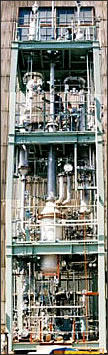
High quality is being demanded in many fields nowadays and so in order to satisfy that we developed a high-purity distillation system in collaboration with Ube industries, Ltd. and Kanto Chemical Co., Inc. The system is used to refine cleaning solutions for the semiconductor industry, medical materials, etc. of high purity (residual ion concentration: 0.01 to 1.0 ppb).
- Our High-purity distillation system provide our clients with high solvent recovery rate, almost 100%.
- The quality of the products/output from our system is very stable, which makes production management very easy, and easier than the conventional ion exchange resin method.
- No emission of waste brings our clients reduction of running cost for environmental measures.
- Our various devices minimize entrainment.
- To prevent the elution of metal, you could ask us the system made of Teflon.
- Our High-purity distillation system has been already proved for solvents that trigger very rapid decomposition reactions, such as hydrogen peroxide.
- Product guide
- Alcohol distillation
- Distillation equipment
- High-purity distillation system
- Membrane separation type solvent dehydration system
- Reactor
- Evaporative concentration equipment
- Coulter spray dryer
- Microwave treatment system
- Filter dryer
- OS filter (continuous vacuum rotating filter)
- Hydrocyclone (liquid cyclone)
- Thermal oil heater (heat medium boiler)
- Process air heater (air heater)
- Ammonia treatment system
- Catalytic deodorizing equipment for ammonia and VOC gas
- Stationary cryogenic storage tank
- Portable cryogenic container
- Cryogenic liquefied gas evaporator